


Call Us
888.433.2300



Description
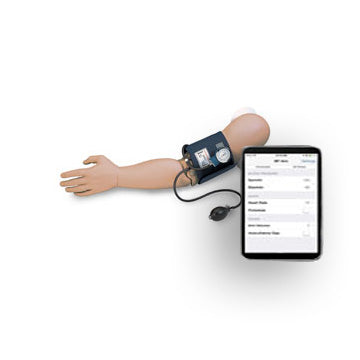
Standalone Arm: The product consists of a realistic-looking arm that can be attached to a manikin or used independently.
iPad Control: The simulator is wirelessly controlled by an iPad, allowing an instructor to set and change systolic and diastolic pressures, pulse rate, and auscultatory gap in real-time. This dynamic control enables the instructor to create a wide range of patient scenarios.
Realistic Feedback: The simulator provides realistic auditory feedback through a speaker, which produces Korotkoff sounds that are audible with a standard stethoscope. It also provides palpable pulses and a variable pulse rate.
Realistic Pressure: The cuff inflates and deflates, and the pressure can be adjusted to simulate different blood pressure conditions. The pressure from the sphygmomanometer matches the pressure on the iPad screen.
Compatibility: The arm can be used as a standalone training tool or can be attached to most standard manikins to enhance the realism of a full simulation.
The Blood Pressure Simulator with iPad Technology is used in healthcare education to:
Teach Blood Pressure Measurement: It provides an excellent platform for students to learn and practice the correct technique for taking manual blood pressure, including proper cuff placement, inflation, and auscultation of Korotkoff sounds.
Practice Clinical Skills: It allows students to develop their skills in physical assessment and to differentiate between various blood pressure readings, including normal, hypertensive, and hypotensive states.
Supplement Simulation Training: It can be used to add a new level of realism to existing manikin training, enabling students to perform a complete patient assessment, including vital signs.
Remote and Individual Practice: Because it is a standalone unit, it can be used for individual, self-paced practice or in a remote learning environment, allowing students to train without direct instructor supervision.