

Call Us
888.433.2300

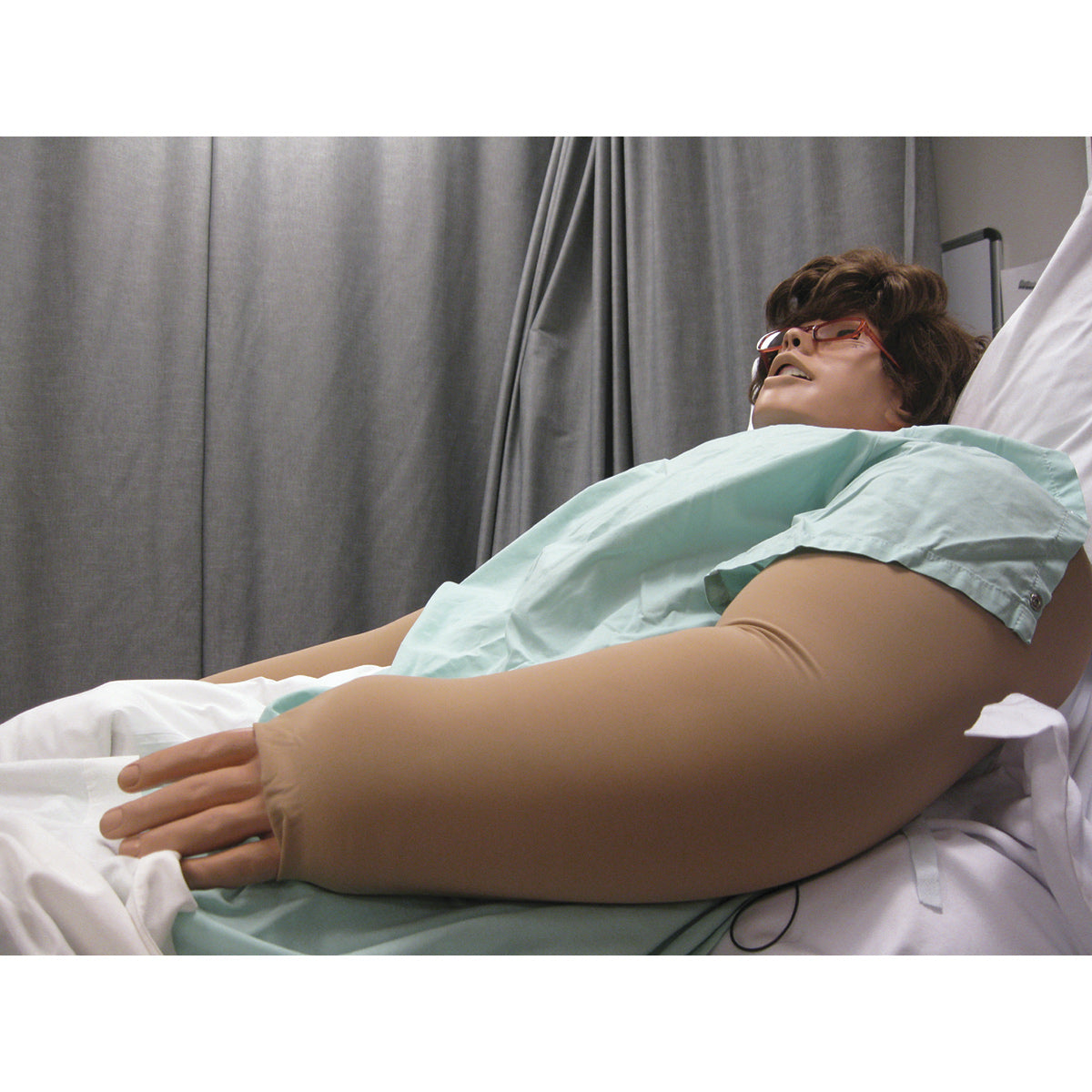


Description
Realistic Simulation: Designed to accurately mimic the look and feel of a human arm affected by lymphedema. It replicates the characteristic swelling, skin texture, and pitting edema (an indentation that remains after pressure is applied).
Wearable Design: The sleeve can be easily worn by a standardized patient (an actor trained for medical scenarios) or fitted onto a manikin, providing a lifelike training experience.
Durable and Reusable: Constructed from high-quality, resilient materials that can withstand repeated use in a classroom or clinical training environment, including the application of lotions and bandages.
Hands-On Practice: Allows for direct physical interaction, enabling students to practice tactile skills that are difficult to learn from textbooks alone.
Safe Learning Environment: Provides a safe way for students to practice and refine their techniques without any risk of causing pain or harm to a real patient.
The primary use of the Simsleeves Lymphedema is to educate and train healthcare students and professionals. Specific applications include:
Patient Assessment: Training students on how to properly conduct a physical assessment of a lymphedematous limb, including visual inspection and palpation to identify the stage and severity of the condition.
Manual Lymphatic Drainage (MLD): Serving as a practice model for learning the specific, gentle massage techniques used to manually move lymph fluid and reduce swelling.
Compression Bandaging: Allowing trainees to practice the precise application of multi-layer, short-stretch compression bandages, which is a fundamental skill in Complete Decongestive Therapy (CDT) for lymphedema.
Clinical Competency Evaluation: Used by instructors to observe, evaluate, and certify that students have mastered the necessary hands-on skills for lymphedema management before they work with actual patients.
Patient Empathy and Communication: Helping students understand the physical manifestation of lymphedema, which can foster greater empathy and improve their communication skills when explaining the condition and treatment to future patients and their families.